
Behind the Scenes: How a Private Chef Preps
Behind the Scenes: How a Private Chef Preps
Curious how private chefs prep an in-home dinner? Guests see the seared scallop on the plate. They don’t see the four hours that came before. The drive to Newport Seafood at 6 AM. The phone call to the farm in Tiverton to confirm the heirloom tomatoes are ready. The two pints of cream that got picked up from Narragansett Creamery on the way back to the kitchen. The sauce that’s been reducing on a back burner for forty minutes by the time the first guest is parking the car.
That’s the part guests don’t see. It’s also the part that makes the dinner work.
This post is the behind-the-scenes version. The seven steps that happen before I plate the first course of your dinner. Most of it is invisible to the host. All of it is what separates a private chef dinner from a takeout meal in nice plates.
Step 1. Menu Consultation and Event Blueprint
Before I shop, before I cook, before I think about plating, I build a blueprint for the night. The menu I send you is one piece of it. The other pieces are the ones you don’t see.
For each dish, I work out the timing backward from when the plate hits the table. The braise for the short ribs needs six hours, so it starts the morning of, sometimes the night before. The hollandaise on the brunch benedict is a three-minute job that has to happen sixty seconds before the plate goes out. The pavlova meringue gets baked the night before because it has to dry, but the macerated berries are cut twenty minutes before service so they don’t lose their structure.
I also work out the equipment. Will I need to bring my immersion blender or does the kitchen have a working one? Is there a sheet pan rack here, or do I bring mine? Does the oven hold temperature? (Some kitchens, especially in older Newport homes and vacation rentals, have ovens that run twenty degrees off the dial. I check.) Is there counter space for a plating station, or do we need to set up a folding table?
The blueprint covers all of it before I leave my own kitchen. By the time I show up at your door, the night is already mostly planned.
For more on the planning conversation that comes before this, see the personalized menu guide post.
Step 2. Ingredient Sourcing
Private chefs don’t shop the way most people do. There’s no one-stop trip to the grocery store the morning of the event. There’s a route.
Newport Seafood for the fish and shellfish, often the morning of, sometimes the day before for fish that’s better with a few hours to cure. Aquidneck Meat for the filet, ribeye, lamb, and pork (called ahead so the cuts are ready when I show up). Clements for produce, including specialty items I’ve requested in advance like specific apple varietals or the soft shell crab when it’s running. Narragansett Creamery for the cheese boards and the cream and butter. Local farms in Tiverton and Little Compton for heirloom tomatoes in summer and storage root vegetables in winter. A specialty importer for the saffron, the truffle oil, the bottarga, the things you can’t get at a supermarket.
The route gets planned the day before. I drive it in order, ice for the cold stuff in the cooler in the trunk. By the time I’m back at my kitchen, every ingredient for the dinner is in place. Nothing got forgotten. Nothing has to be substituted at the last minute.
A FOUR-COURSE DINNER FOR TEN
The Day in Hours
SOURCING · PREP · SERVICE · CLEANUP
6:00 AM
Sourcing Run
Newport Seafood, Aquidneck Meat, Clements, Narragansett Creamery
9:00 AM
Mise en Place
Vegetables, proteins, sauces, dessert components, labeled and packed
3:30 PM
Arrive On-Site
Unload, set up stations, pre-warm pans, finish prep
6:00 PM
Guests Arrive
Service begins. Hot food on the table within fifteen minutes.
10:00 PM
Reset and Depart
Kitchen looks like the morning. Leftovers labeled. Chef’s car loaded. Goodnight.
Sample timeline · Yours flexes around the menu, the headcount, and the room.
Step 3. Mise en Place
Mise en place is the whole job before service. The phrase is French for “everything in its place.” Everything you can do early, you do early. The actual cooking on the night becomes assembly and finishing instead of a panic.
For a four-course dinner for ten guests, mise en place might include:
- Vegetables peeled, diced, blanched if needed, stored in labeled containers by course
- Proteins trimmed, seasoned, marinating in their pans, refrigerated
- Stocks and sauce bases reduced and held in deli containers, ready to finish
- Blanching done for any vegetables that get a final sear (Brussels sprouts, asparagus, broccolini)
- Compound butters made and chilled in logs, ready to slice over the protein
- Vinaigrettes whisked and held in deli containers
- Dessert components built (pavlova meringues baked, panna cotta set in molds, tart shells blind-baked)
- Plating tools laid out (squeeze bottles for sauces, tweezers for garnish placement, plates wiped and stacked)
Every container gets labeled with what’s inside and which course it belongs to. Then it all gets packed for transport, cold stuff in the cooler, room-temperature stuff in stackable insulated bins. Loaded into the car the morning of the event.
By the time I leave my kitchen, the dinner is already 80% prepped. The last 20% is the part that has to happen on-site, hot, and timed.
Step 4. Day-of Kitchen Setup
When I arrive at your house, the first thirty minutes are setup. I unload everything from the car and turn your kitchen into a working line.
Stations get organized by course. Cold station (salads, crudo, dessert components) gets the side of the kitchen with the most fridge access. Hot station gets the side with the burners and oven. Plating station goes wherever I have the most counter space, usually the island. Knives go on a magnetic strip on the counter or in a roll within reach. Sheet pans pre-warmed in the oven for the proteins. Hollandaise pot on the back burner with butter at room temp.
If you’re hosting on a porch or in a setup where the dining table is far from the kitchen, I scout the path and figure out plate carry. The plate that leaves the kitchen looking perfect needs to look the same when it lands.
By the time the first guest rings the bell, the kitchen looks like a restaurant line and the dinner is ready to start moving.
Step 5. Cooking, Finishing, and Plating
This is the part that looks easy. It’s not.
Plated multi-course service is a timing exercise. Course one needs to land hot in front of every guest at the same time. Course two has to start prepping while course one is still being eaten. Hollandaise has to be ready exactly when the eggs are. Sauces have to be at the right temperature. Proteins have to come out of the pan when they hit the right internal temp, not when they look right. Plating has to happen fast enough that the food is hot when it leaves the kitchen.
For a four-course dinner for ten guests, that’s about ninety to one hundred plates moving in and out of the kitchen across two hours. Every plate gets sauce, garnish, salt, sometimes a finishing oil or a microgreen, then a wipe of the rim. Then it goes out.
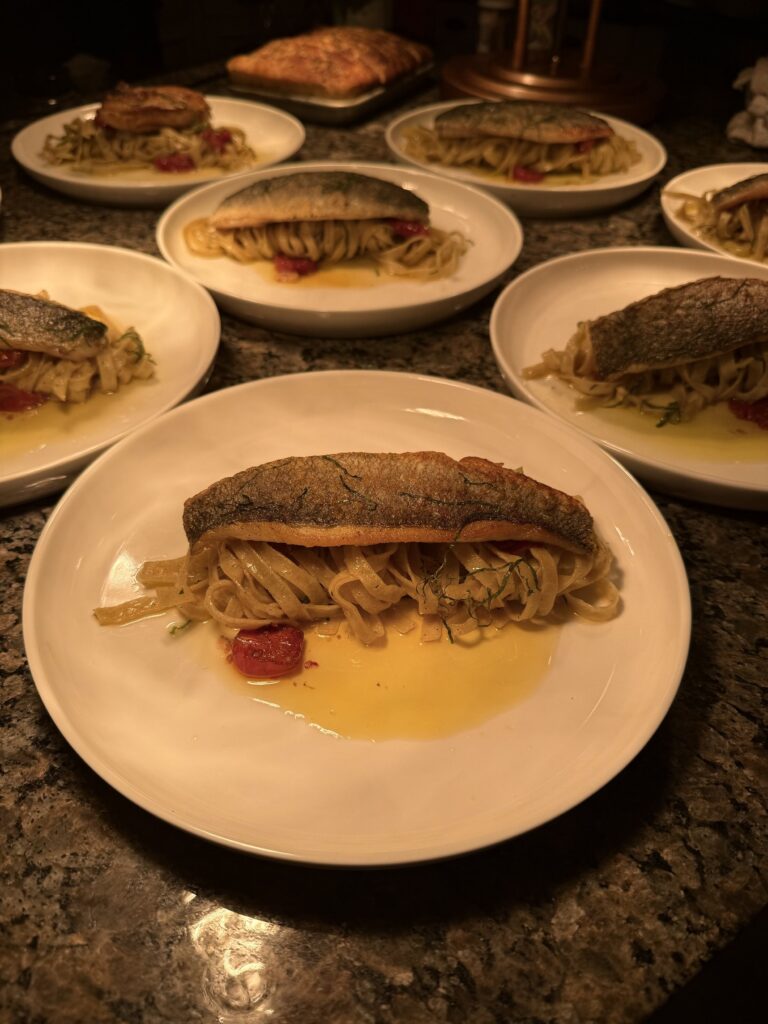
This is where technique shows. A pan-seared scallop with the right crust on a sweet corn velouté on a clean plate looks like a restaurant dish. Same scallop, same sauce, on a smudged plate or with the sear half-done, looks like a home dinner that someone tried hard at. The difference is execution under pressure, and the pressure is where the prep pays off. If mise en place was done right, plating becomes the moment everything comes together. If mise en place was sloppy, plating becomes the moment everything falls apart.
Step 6. Service
What guests see during the meal is the part that took the rest to make possible.
Course pacing. Plate clearing. Refilling water. Topping off wine if you’ve handed me the bottles. Reading the room and slowing down or speeding up between courses based on how the table is doing. Answering questions about the dishes when guests ask. Refilling the bread basket. Checking on the guest who hasn’t touched their main and quietly asking if there’s something I can do (a dietary restriction missed, a dislike, a kid who’d rather have plain pasta).
Service is the part guests actually see. The cooking is the part that earns it. Most caterers skip the service piece because the chef leaves after the food is dropped off. A private chef stays in the room the whole night.
Step 7. Cleanup and Kitchen Reset
After dessert lands and the guests move to the porch with espresso, I start the reset.
Dishwashing. Counter sanitizing. Stove and oven wipe-down. Knives cleaned and rolled. Cookware loaded into my own cases. Leftovers packed into labeled containers with reheating instructions. Trash bagged and ready to go. The fridge wiped down where my containers were, so when you open it the next morning you don’t see a mess.
The kitchen looks like the morning, not like a dinner happened. That’s the goal. You wake up Sunday and your kitchen is yours again, not a job site I left behind.
PARTUM EVENTS · RHODE ISLAND & MASSACHUSETTS
Ready to Host Without Cooking?
The behind-the-scenes work happens before guests arrive. Send the date and the headcount.
Inquire About Your EventThe Part Guests Never See, But Always Feel
Most of what makes a private chef dinner work is invisible to the people at the table. The early-morning sourcing trip. The two days of prep. The route in the car. The labeling system in the cooler. The thirty-minute kitchen setup. The timing math behind every plate.
Guests just feel that the night flowed. The food landed hot. The pacing felt right. Nobody had to think about logistics. The kitchen looked clean when they walked in and clean when they left.
That’s the whole job, and most of it happens before anyone arrives.
Frequently Asked Questions
How long does a private chef spend prepping for a dinner?
For a four-course dinner of ten guests, total prep time is usually six to eight hours spread across the day before and the morning of. Sourcing alone is typically two hours. Mise en place is three to five hours. On-site cooking and service is another three to four hours. The visible service portion is the smallest piece of the actual work.
What time does the chef arrive at my house?
2.5 hours before the first guest, every event. Long-prep components (slow-roasted lamb, sauces that need hours of reduction, pastry doughs that need to rest) get done in my own kitchen the day before so the on-site time stays consistent.
Can the chef cook in any home kitchen?
Most home kitchens work fine. The minimum requirement is a working oven that holds temperature, four functioning burners, and counter space for a plating station. If your kitchen has limitations (a small oven, no counter space, an island that’s not big enough), we work around it. Vacation rentals and Airbnbs vary widely; I usually do a kitchen scout during the consultation.
Does the chef bring all the equipment?
Yes. Knives, plating tools, mise en place containers, sheet trays, sauce squeeze bottles, garnish tweezers, immersion blender, kitchen torch, and any specialty equipment for the menu. The host provides the working kitchen and the dining table.
Do you handle leftovers and cleanup?
Yes. Leftovers get packed in labeled containers with reheating instructions. The kitchen gets dishwashed, sanitized, and reset before I leave. The fridge is wiped down where my containers were. The kitchen looks like the morning, not like a dinner happened.
Can you accommodate dietary restrictions in your prep?
Yes. Vegan, gluten-free, dairy-free, vegetarian, pescatarian, severe nut allergies, celiac, kosher-style, halal, allergen-specific. ServSafe Food Protection Manager and ServSafe Allergen certified. Cross-contamination prevention is built into mise en place from the first containers.
What’s the price range?
Pricing details live in the cost guide.
Reserve Your Date
If you’re planning a dinner in Rhode Island or Massachusetts, reach out with the date, headcount, and a rough sense of what you want. A custom menu and quote come back within 24 hours.
For more on the process, see the personalized menu guide, what to expect when hiring a private chef in RI, or the private chef cost guide.
Related resource: ServSafe certification.
Reserve your how private chefs prep date.
Send the date, headcount, and a rough sense of what you want the night to feel like. I’ll come back with a custom menu and quote within 24 hours.
Reserve your date